
Guide
Directional drilling or open trenching?
Horizontal directional drilling suits crossings and obstacles, and open trenching suits long clear runs of new pipe and conduit in Sydney and NSW. This Spot On Excavations guide compares them with a decision table and explains how trenchless installation differs from pipe relining.
The difference in one paragraph
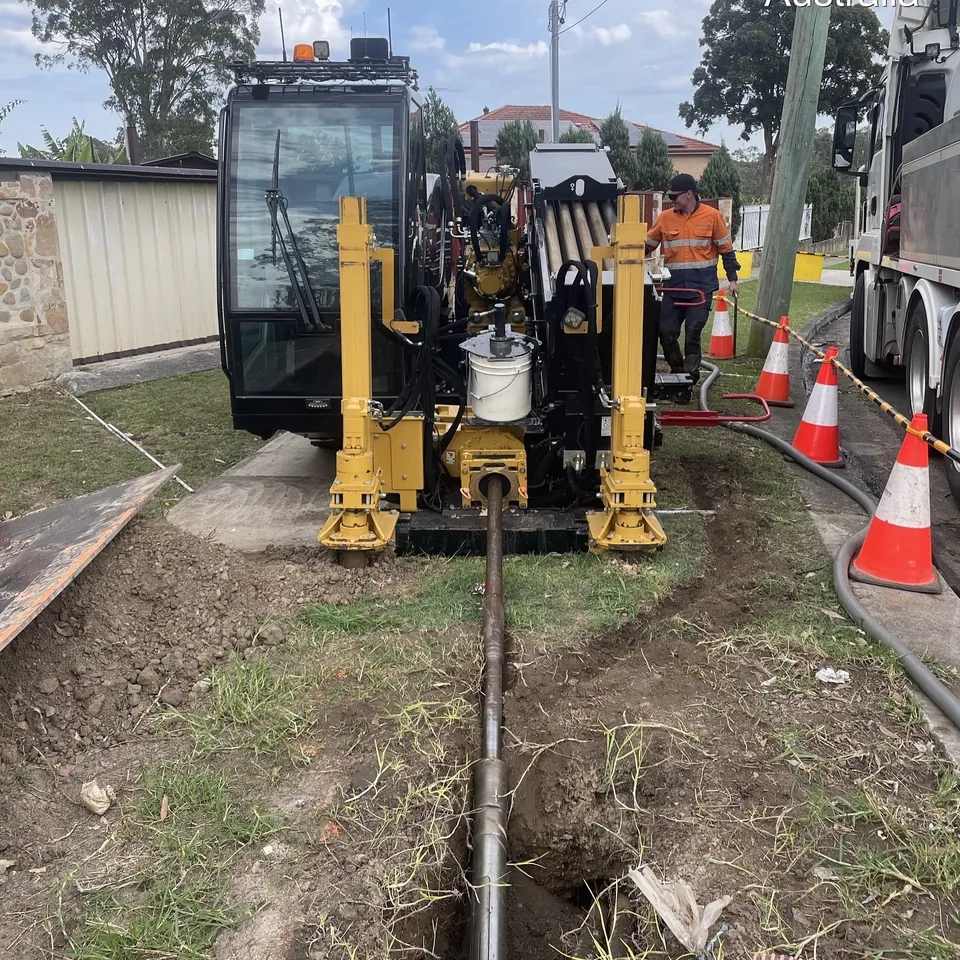
Open trenching digs a continuous trench, lays the pipe or conduit, backfills and reinstates. Horizontal directional drilling steers a bore underground between two pits and pulls the product through. The question is which disturbs less and costs less for your route, and the answer changes with the ground, the surface and what is in the way.
A trench leaves a continuous strip to backfill, compact and reinstate, which is where much of its cost and disruption sits. A bore leaves two pits. That trade-off drives most decisions: trenching is simple and visible, while drilling moves the work underground and trades pit work for rig time. Questions to settle first are what is on the surface, what is below it, how long the run is and who owns the ground.
When HDD is the better choice
- The route crosses roads, driveways, paths, creeks or car parks that would otherwise need cutting and reinstating.
- Trees, buildings or surface features sit on the line.
- Traffic or access would make a long open trench difficult.
Our horizontal directional drilling and road and creek crossing pages describe how we do this.
When open trenching is the better choice
- The run is long, straight and through clear ground.
- The route needs frequent pits, junctions or fittings.
- Cover is shallow or the pipe cannot take the bend of a bore.
We carry out excavation, trenching and pits as well, so we can compare both for you.
Which method suits which situation
| Situation | Suits |
|---|---|
| Crossing a sealed road or driveway | HDD |
| Passing under a creek, drain or established trees | HDD |
| Long, straight run through open ground | Open trench |
| Many pits, branches or fittings along the route | Open trench |
| Pipe of limited bend tolerance or very shallow cover | Open trench |
| Restoring a damaged old pipe in place | Neither: pipe relining |
The table is a starting point only. Services in the ground, depth and surface owner conditions can change the answer.
What “trenchless” means, and what it does not
“Trenchless” covers several methods for working without a continuous open trench. Directional drilling installs new pipe and conduit. Pipe relining repairs an existing pipe from the inside, usually sewer or stormwater. If you need a new service run under a road, you want drilling, not relining. If you need an old pipe restored, relining is a different trade.
When neither suits
Very large pipe, very long crossings or particular rail and highway conditions may call for pipe jacking, microtunnelling or a specialist crossing method. We will tell you when a job is beyond what our rigs should be asked to do.
Whichever method, locate first
Both methods need services found before ground is broken. We start with Before You Dig Australia (BYDA) plans and expose services with vacuum excavation before drilling or digging. For pricing differences, see how directional drilling is priced.
Questions
Method questions, answered
Is HDD cheaper than trenching?
Not always. Over a short crossing of a road or driveway, HDD often costs less than cutting, trenching and reinstating. Over a long open run, a trench can cost less. We price both when the route allows.
Does HDD avoid digging completely?
No. HDD needs an entry pit and an exit pit, and services are exposed by potholing. It avoids a continuous trench along the route.
Is trenchless the same as relining?
No. Trenchless is a broad term. Relining repairs an existing pipe, while directional drilling installs a new one.
Which is faster?
For a road or creek crossing, a bore is usually faster than trenching and reinstating. For a long open run, trenching can be quicker.
Can you do both on one job?
Yes. A common job bores the crossings and trenches the open sections. We can supply both.
Related
Next step
Not sure which method?
Tell us the route and what is in the way, and we will say which method fits.